
For the man who still loves his wife… but feels more like her roommate

Learn how to bring romantic aliveness back, without pulling away, playing games, or making her question where she stands.

Neuro-Polarity™ is a short, safety-first guide for long-term relationships that have become friendly, functional… and flat.

Discover why rebuilding emotional safety doesn't always bring attraction back by itself, and what to work on next, without manufactured distance, jealousy, or “make her chase” games.

Instant Access: $27

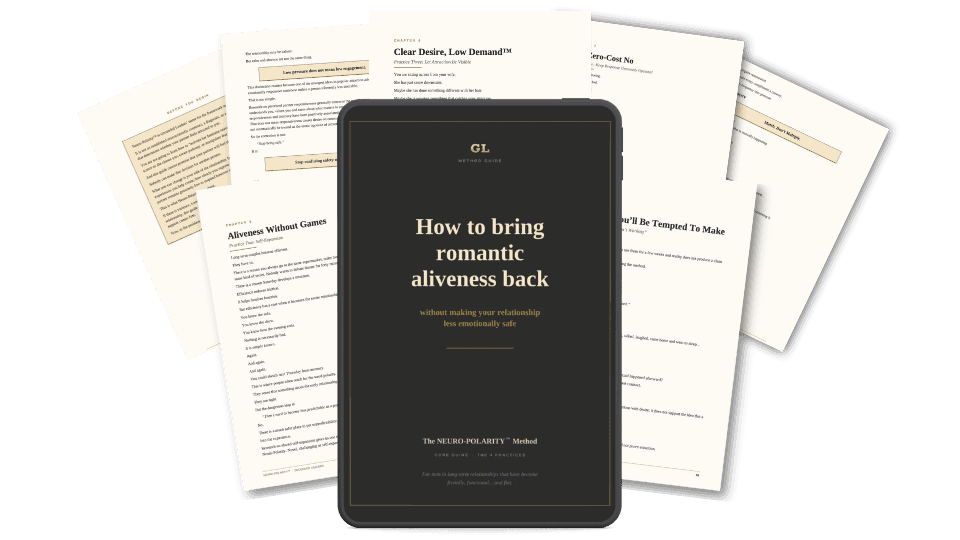
The Neuro-Polarity™ guide on a tablet, surrounded by sample pages from its chapters
30-day money-back guarantee

You can fix a lot in your relationship…and still end up feeling like roommates.

Maybe things are actually better than they were.

You argue less. You listen more. You stopped chasing every cold mood. You became more patient.

Maybe she seems more comfortable around you.

And yet…

  • The kiss is still on the cheek.
  • Conversation is still mostly kids, work, bills, and schedules.
  • Touch feels practical. Flirting disappeared.
  • Sex is rare, predictable, or something neither of you quite knows how to approach anymore.

Nothing is catastrophically wrong. That's what makes this so confusing.

If emotional safety is improving, why doesn't the relationship feel romantic again?

That's what Neuro-Polarity™ was built to address: relationships that stay cooperative and connected while the romantic part has gone flat.

Most men eventually get handed 2 bad options.

Option #1

Become safer until you disappear.

Be patient. Be understanding. Remove pressure. Don't say the wrong thing. Don't flirt unless she goes first. Don't express too much attraction. Don't create tension.

So you become increasingly careful, until there's almost nothing recognizably romantic left in how you relate to each other.

You become safe. Polite. Reliable. And increasingly invisible.

Option #2

Make her less secure so she feels something.

Pull away. Become harder to reach. Stop reassuring her. Text less. Create mystery. Make her wonder what you're doing. Make her feel she could lose you. “Let her chase.”

And yes, that may make someone think about you more.

But thinking about losing someone isn't automatically the same thing as wanting them. Anxiety can create attention, preoccupation, monitoring, pursuit. That doesn't mean it created the kind of attraction you actually want.

Neuro-Polarity™ teaches a third way.

What if the relationship could become more alive, without becoming harder to trust?

You don't need to choose between emotionally safe but romantically dead, and emotionally exciting because she isn't sure where she stands.

Neuro-Polarity™ shows you how to think about attraction differently inside a long-term relationship. Not as something you force. Not as something you negotiate into existence. Not as something you create by destabilizing the bond.

But as something that has more room to emerge when the relationship contains 4 things:

Connection

Aliveness

Visible Attraction

Genuine Freedom

The Framework

The 4 things Neuro-Polarity™ works on.

Practice 1

Safety Without Flatness

A man learns not to pressure his wife. Good instinct.

Then, slowly, he starts editing himself around every reaction she has. More agreeable. More cautious. Less willing to initiate anything, romantic or otherwise.

He's behaving better. He's also getting harder to encounter as a romantic partner.

“Where do you want to go for dinner?”
“I don't know, wherever you want.”

The disappearing version

He says this most weeks. No real preference, agreeable by default, because having a preference feels riskier than simply being agreeable.

The safe-and-present version

He actually picks. Names the place, states the preference, stays open if she'd rather do something else. Small decision. But it's the difference between being present in the room and just being agreeable in it.

The line isn't between being emotionally responsive and disappearing in the name of responsiveness. And the fix isn't performing more “alpha” energy either.

Practice 2

Aliveness Without Games

Early on, she was novel. You were still learning how she thought, what made her laugh, what she was like in situations you hadn't seen yet.

Years in, you know the sofa, the restaurant, the Thursday routine. You know what she'll say. She knows what you'll say.

Most advice looks at that gap and says: become less predictable. Pull back. Create mystery.

Same Tuesday, same takeout order.

The manufactured version

He cancels plans last-minute or goes quiet for a day, hoping the uncertainty reads as intriguing.

The alive version

He brings something into the evening that's never been there before. Small enough that nothing about the relationship gets less certain, but enough that something about the evening does. What that actually looks like on a random Tuesday is the specific part most “add novelty” advice skips.

One creates insecurity. The other creates discovery. Confusing the two is what sends men straight into hot-and-cold behavior.

Practice 3 · The Center of the Method

Clear Desire, Low Demand™

If affection has started feeling like a request, start here.

Most men land in one of two places: hide the attraction and slowly become roommates, or show it and worry every compliment now reads as the opening move of something.

“You look great tonight.”

The loaded version

He says it, then moves in, watches her face for a signal. The room is now waiting on her reaction.

The clear-desire version

He says it, means it, and keeps moving. Back to the dishes, the conversation, whatever he was doing. Nothing was withdrawn. Nothing has to happen next.

Say what's true. Attach nothing to it. The exact wording that pulls that off without sounding flat or performative is smaller than most men expect. It's the first thing this chapter fixes.

Practice 4

The Zero-Cost No

A man can be completely calm walking into an initiation. Then she says not tonight.

And the mood shifts. He goes quiet. Asks if something's wrong. Needs a little reassurance. Tries again later. The rest of the evening feels different than it would have otherwise.

He never says you owe me. He doesn't have to. He's still made a no expensive.

She says she's tired, not tonight.

The costly version

A flicker of disappointment he thinks he’s hiding, a slightly cooler tone for the evening, checking in twice to see if she’s “okay.”

The zero-cost version

He’s the same guy 5 minutes later that he was 5 minutes before she said no. Same tone, same mood, nothing to manage.

One more thing most men get wrong.

She warms up. Laughs at something you said. Sits a little closer. Kisses you a beat longer than usual.

And your mind starts running:

Is this a sign? Should I do something? Will I miss the window?

That's usually where progress turns into pressure.

The guide calls this “Read the Moment, Don't Run a Script”: staying inside a good moment instead of immediately trying to turn it into proof, or a project, or the next move.

It might matter more than anything else in here.

What if she just doesn't feel desire first?

Some couples get stuck here specifically. A lot of advice assumes desire only works one way: want, then act.

Long-term desire is often more complicated than that; it can be responsive, showing up after connection starts rather than before it.

What this is, and isn't.

Neuro-Polarity™ doesn't promise your wife's desire. No product honestly can, and one that says otherwise is selling you something false.

What it does is help you find and stop the things that quietly work against the relationship you actually want: treating patience like an investment with a payout attached, letting affection feel like the opening move of a request, mistaking her insecurity for her interest.

It's a proprietary Grounded Leaders framework, not a clinical intervention. It draws on research in partner responsiveness, novelty in long-term relationships, sexual autonomy, and how people respond to rejection.

The Guide

Neuro-Polarity™

How to bring romantic aliveness back without making the relationship less emotionally safe.

The Neuro-Polarity™ guide on a tablet, surrounded by sample pages from its chapters

Digital Guide · Instant Access

Read tonight. Know what to do differently tomorrow. That's the bar this was built to clear. Not another book that sits half-finished on the nightstand.

Inside

  • The 4-practice Neuro-Polarity™ framework, in full
  • Readiness Check: so you're applying this to the right problem, not the wrong one
  • Real relationship scenarios, walked through practice by practice
  • Neuro-Polarity™ Quick Reference: 1 page, for the nights you don't want to re-read a chapter
  • Research notes on exactly where the science ends and the framework begins

11 chapters. About 60–90 minutes, start to finish.

A few things inside that we haven't talked about here

  • Why some “romantic effort” quietly creates debt, and the test in the guide that exposes it fast
  • Why polite wording alone doesn’t make something low-pressure, and the factors men actually miss
  • The responsive-desire mistake that makes things dramatically worse, and the guardrail that prevents it
  • Why handling rejection perfectly can still turn into manipulation, and how to catch it in yourself
  • When to stop using technique altogether, because sometimes the next move isn’t better polarity, it’s an honest conversation
Today:$27

Digital Product · Instant Access

30-day money-back guarantee badge

Read It. Then Decide.

Read it. If it doesn't give you something concrete to change in how you show up, email us within 30 days for a full refund.

Who this is for, and who it isn't.

Who this is for

For the man thinking: “We still care about each other. We just don't feel like a couple anymore.”

Good fit if your relationship is reasonably cooperative or improving, the romantic side has gone flat, conversation is mostly logistics, touch feels practical, and you're tired of advice that tells you to get colder or harder to reach.

Who this isn't for

Neuro-Polarity™ isn't a shortcut around unresolved protection. If she's strongly guarded, afraid of your reactions, asking for real distance, or actively choosing to leave, the problem probably isn't a lack of polarity, and the guide's own Readiness Check will tell you that before you spend the 90 minutes.

This is actually urgent.

Flat doesn't hold still. A cheek-kiss you've done for 2 years gets more automatic, not less. The longer flirting stays gone, the more foreign it feels to bring back, and the more loaded any attempt at it starts to feel to both of you.

Nothing here is time-sensitive. The problem is.

Every month in roommate mode is a month you're both a little more fluent in roommate mode, and a little less practiced at the alternative.

Frequently asked questions

Imagine something

You're sitting together one evening. Nobody's discussing the relationship. Nobody's trying to fix anything.

She says something. You make her laugh. You look at each other.

And for a second, it doesn't feel like two roommates running a household.

There's just something between you again.

For the first time in a while, the relationship holds something besides kids, chores, work, and repair.

It's possible.

Get instant access to Neuro-Polarity™.

A safety-first framework for bringing romantic aliveness back into a relationship that's gone friendly, functional, and flat.

  • The full Neuro-Polarity™ guide: all 11 chapters
  • The 4-practice framework: walked through with real relationship scenarios
  • Readiness Check: so you're applying this to the right problem, not the wrong one
  • Research notes: exactly where the science ends and the framework begins

Read in about 60–90 minutes. Start with your side. She doesn't need to participate.

Today:$27

Read tonight. Know what to do differently tomorrow.

Start with your side of the relationship.

30-Day Money-Back Guarantee · Secure Checkout