How to rebuild emotional safety at home - in 10 minutes a day
Help her get out of protection mode with the 10-Minute Emotional Safety Reset so she can actually feel safe around you again. No chasing, no games, no manipulation.
If she feels distant, cold, or done with you,this is for you.
It's the worst feeling in the world.
She’s not looking at you the same.
Every conversation turns into a fight or ends in silence.
She says she needs “space.”
You feel more like roommates than partners.
The silence between you is getting deafening.
You keep replaying everything you did wrong in your head.
And no matter what you try…
Texting. Apologizing. Giving her time.
It feels like nothing works.
You feel stuck. Powerless. Alone.
You're trying to fix the wrong problem.
Her brain doesn't feel emotionally safe around you anymore.
That's not an insult.
That's neuroscience.
Right now, her mind is stuck in protection mode.
The amygdala. The part of her brain currently deciding you're a threat.
That means everything you say or do gets filtered through a lens of:
“Is this going to hurt me again?”
Even if you're being calm…
Even if you mean well…
Even if you've changed…
She can't feel it.
Because her nervous system is locked in defense.
From the Desk of Peter
There was a moment I damaged my partner's trust in me. She told me she was pregnant, and instead of showing up, I hesitated. I said “Everything will be fine.” But my actions said I had one foot out the door.
I felt like I wasn't ready to have kids and I was too scared. I wasn't sure if I should leave or if I should stay. She felt all of it. Of course she did.
You can't say the right sentence while your whole body is telling her you're not safe to count on.
I tried to fix it the way you probably have. Explaining. Apologizing. Defending myself. But the scar was too big. None of the words I said reached her.
Only when I created emotional safety, in a very specific order, did anything actually reach her. In my case, what we rebuilt ended up stronger than what we had before the damage.
Small, deliberate actions that started shifting things sooner than I expected. Then at some moment something shifted in her that her thinking couldn't argue with. She softened before she'd decided to.
And then I had to make it last, so one hard night didn't undo months of work.
I couldn't have found any of this on my own. Studied, researched, asked, and got mentored. It had a structure, and there was real science underneath it. That structure is what became the two phases of NETR.
But I won't pretend my story is the proof. The men in our community are. They used these steps from far colder places than mine and told us what actually worked, until we'd refined it into something that holds.
What's inside isn't one man's lucky story. It's what worked for the men who walked this road before you.
Peter
Don't take our word for it
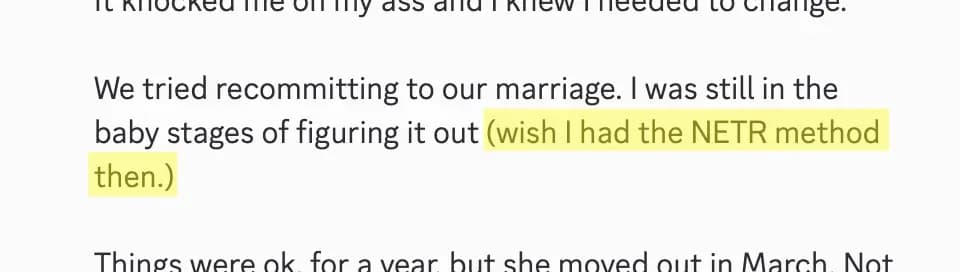
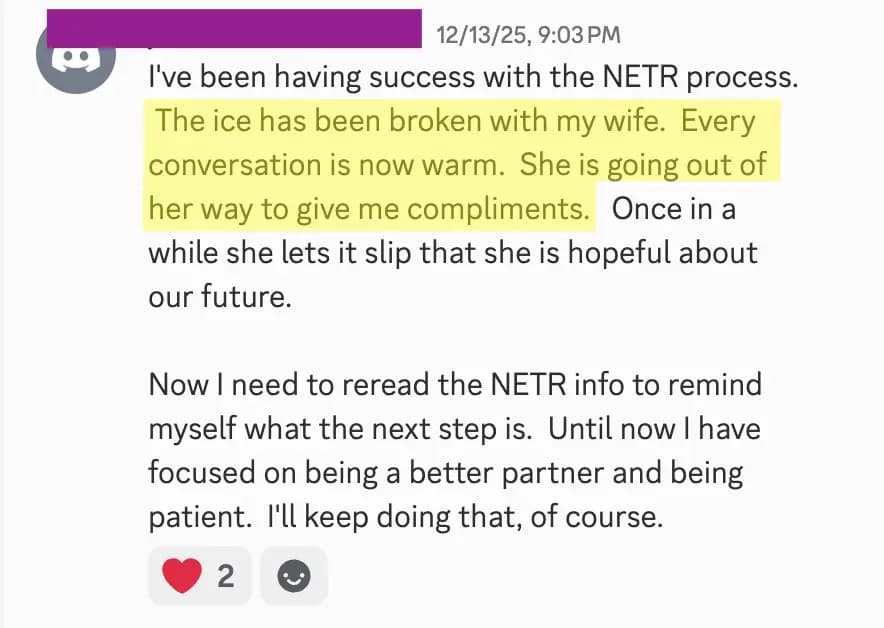
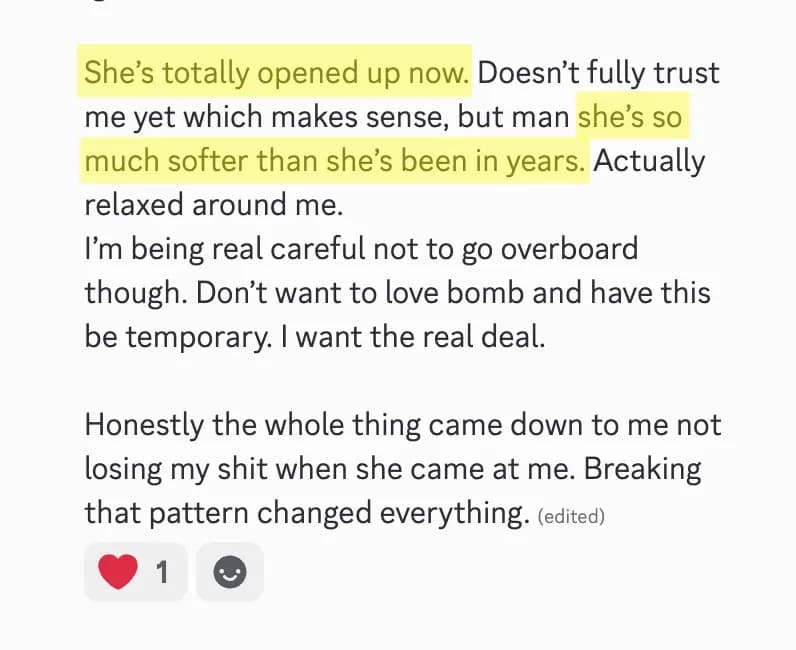
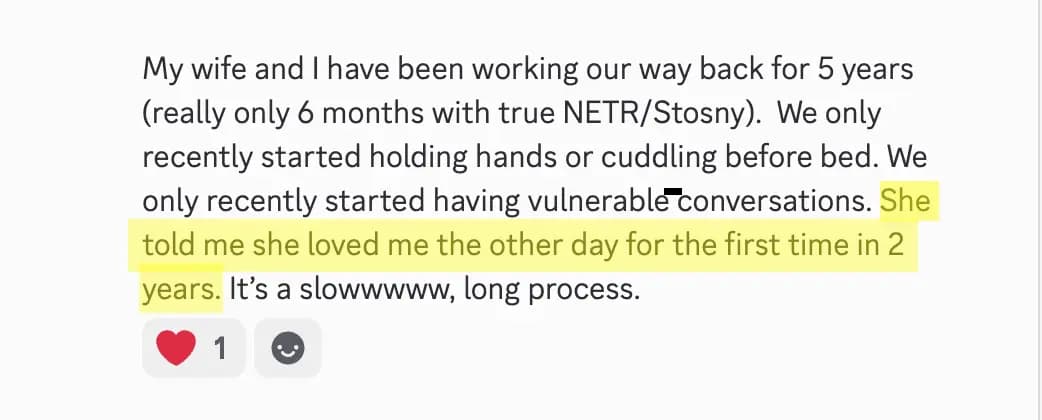
This is what changes.
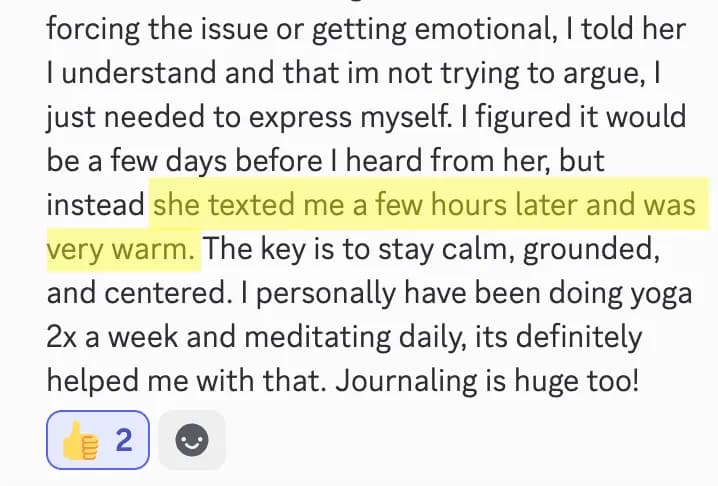
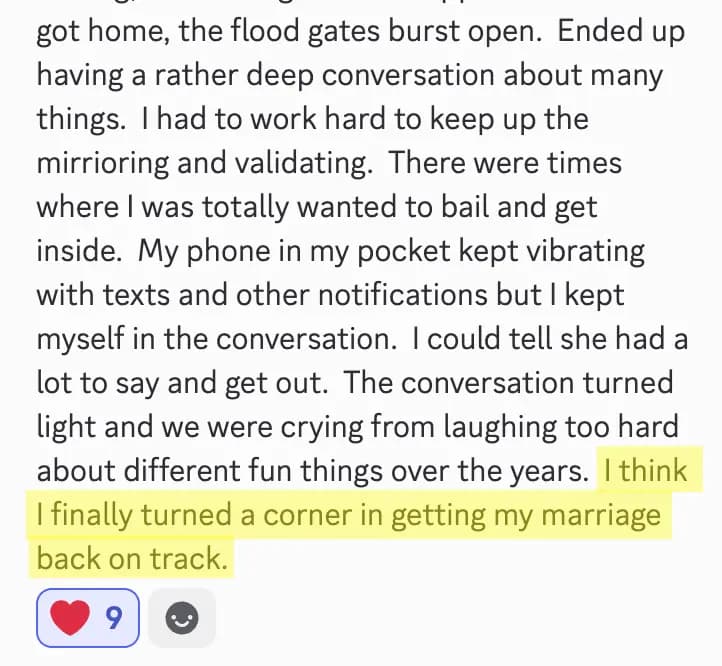
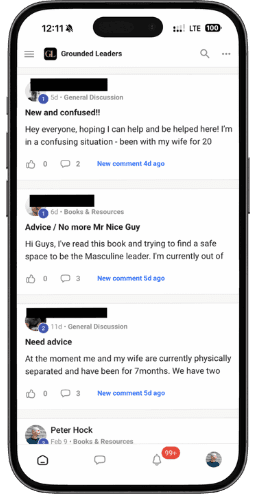
Real messages from the men who did the work.
Real screenshots from our private community. Usernames anonymized.
When she's in Protection Mode, talking it out backfires.
When she doesn't feel emotionally safe:
She avoids real conversations.
She gets defensive or shuts down.
She sees you as the stressor (even when you're trying to fix things).
The more you try to explain yourself, the worse it gets.
It's Not Your Fault. You've Been Set Up To Fail.
Here's the truth no one talks about:
No Lived Experience
People haven’t been in your situation.
Most people telling you to “just move on” have zero idea what you’re actually feeling or what your situation is really like.
Missing Education
No one teaches us this.
No one ever taught us how to build or repair a relationship, yet somehow you’re expected to just “figure it out.”
Therapy Limits
Therapy has limits here.
Couples therapy only works if both people are still willing to engage. When her nervous system has shut down, sessions often make things worse.
Manipulation Backfires
Manipulative advice won’t work.
Most “get her back” advice online is built on manipulation. It backfires because her nervous system reads it instantly.
You're not weak. You're not broken.
You've just never been given a real strategy.
Until now.
The Fix
Use The NETR™ Method to bring her nervous system out of Protection Mode.
This isn't manipulation.
This isn't about begging or pretending to be someone you're not.
This is a strategic reset that helps her nervous system stop reading you as a threat…
…and start reading you as someone safe to trust again.
The NETR™ Method works in 2 phases
1Phase One
The Emotional Safety Reset
The 10-Minute Pattern That Starts Lowering Her Guard Fast.
The first thing you do is interrupt the emotional “danger loop” her brain runs every time she's around you.
Inside this phase, you'll learn:
The exact 10-minute exercise that starts lowering her guard from the first day you run it.
How to change what your presence signals to her before you even say a single word.
The key to calming her nervous system so she has room to open up again.
Why attraction fades when emotional safety is missing and the exact shift that rebuilds the foundation it runs on.
“After applying this, she literally looked at me differently. Like a weight was off. We actually had a real conversation for the first time in weeks.” – Ethan R.
Verified Customer
2Phase Two
Make the safety last
Once her guard starts coming down, you rebuild trust without forcing it.
In this phase, you'll learn:
The Trust Trinity™: the three signals that let a guarded nervous system start opening up, in the order it actually accepts them.
The Respect Signal™: a 5-minute daily action that broadcasts a signal of respect she feels immediately.
The Emotional Rebalance: how to shift the dynamic so you’re no longer the one chasing.
The 3 “fix-it” mistakes most men make that quietly push her further away, and what to do instead.
By the end of Phase 2, you're no longer “trying” to get her back.
You've become someone steadier, and the pressure she's been bracing against simply isn't there anymore.
“She told me, ‘Something's different about you.’ That's when I knew it was working.” – Grayson W.
Verified Customer
What happens when men start applying NETR™.
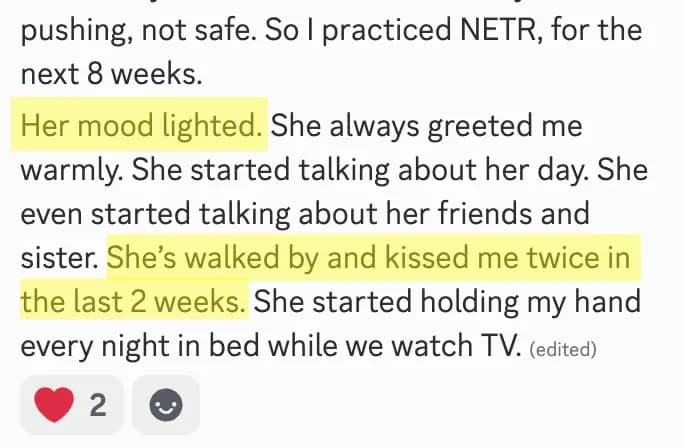
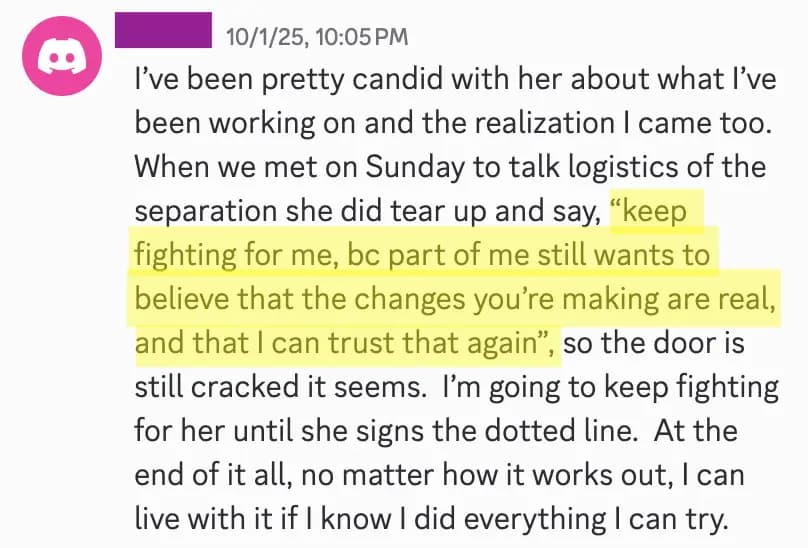
The proof isn't in the explanation. It's in what changes for the men who do the work.
Real screenshots from our private community. Usernames anonymized.
Will the NETR™ Method work for you?
It's the question every man in your position asks:
“But is my situation different? Is it too far gone?”
You feel like your circumstances are uniquely difficult. And you're right, the details are yours alone.
But the underlying human biology is universal.
Her nervous system runs the same Protection Mode response whether she's in the next room or across town. Whether she moved out last week or two years ago. Whether the breach was an affair or just years of small letdowns.
The mechanism is the same. Which means the method applies, regardless of the specifics.
See if your situation falls into any of these:
And who this is not for:
We're not going to tell you the method works for every situation. We don't know your situation. What we do know is that the underlying mechanism, switching her nervous system out of Protection Mode and restoring the emotional safety beneath it, applies regardless of the specifics.
The question isn't whether the method fits your situation. It's whether you're willing to do the work even when the outcome isn't guaranteed.
Here's everything you get inside the NETR™ System.
Everything you need to lower her Protection Mode and rebuild the emotional safety between you.
Digital Download · One-Time Payment · Instant Access
Here's what's inside
The Core
The NETR™ Method
The full system for switching off her Protection Mode and rebuilding emotional safety at the nervous system level.
The full system, across both phases:
Phase 1
The 10-Minute Emotional Safety Reset™
The Four Respect Signals™
The Pattern Interrupt™
The Mirror & Validate Method™
Phase 2
The Trust Trinity™
The Patience Principle™
The 20-Minute Rule™
The Field Effect™
A short, focused course with interactive exercises. You can start running it within hours of buying it.
$97 value
Plus
Get it today and you also get a free bonus.
+Bonus
The Grounded Leaders Community
A quiet room of men doing this work, holding each other to it.
Real questions, shared experiences, and daily support from men doing this work. Men a few weeks ahead of you, men a few months in, men who've come out the other side.
It's not a forum. It's a quiet room of men holding each other to the work.
You don't have to use it. It's there when you need it.
Try the NETR™ Method for 30 days. Run the daily practice. Read the framework.
If you don't feel more in control of what happens next. If you can't see the path forward more clearly than you could when you arrived. Email our team and we'll refund every cent. You keep the method.
For many men, that clarity is exactly what their wives begin responding to.
Peter, Co-Founder
Your purchase is private. The product name will not appear on your card statement. No one will know unless you tell them.
Why men recommend us
“My relationship is different now. I’ve become a new version of myself, and it shows. We’re communicating better than ever and even planning a vacation together. It would’ve taken me much longer, or it might not have happened at all. It lays out exactly what steps to take and what to watch out for. It’s a transformation on many levels.”
Derek L.
Verified Customer
“After 7 months, we moved back in together. Before that, we went on “dates” to reconnect. It feels like we’re starting fresh, as though we’ve erased the past. The NETR™ System showed me exactly how to behave in a healthy relationship.”
Grayson W.
Verified Customer
“Our relationship has improved so much, especially our communication and his interest in me. What made the biggest difference was the knowledge he gained from Peter. Everyone involved is incredibly supportive.”
This is a predictable shift. Forget what doesn't work. Here is a window into what happens when you start applying what does.
Week 1: The Stillness
You stop the chasing and begin to operate with a new, deliberate strategy. The ground returns beneath your feet.
Week 2: The Echo
She feels the shift. Your calm presence creates curiosity, not pressure. The tension breaks. Your silence starts to speak.
Week 3: The Gravity
Your happiness is no longer tied to her response. This self-possessed energy is magnetic. You are no longer the man she pulled away from; you are becoming the man she would be curious to know again.
Week 4 & Beyond: The Re-Entry
She begins stepping back into your life, but on a completely new foundation. You didn’t just change her mind; you changed how her nervous system feels when you walk into a room. And that is a rock-solid foundation you can build a new life on.
This isn't magic. It's a structured method.
Start now, before the distance becomes permanent.
The questions men ask before they start
We are confident this system will give you the clarity and tools you need. However, if you complete the program, do the required work, and still don’t feel it has given you a powerful new perspective and a clear path forward, we offer a 30-day results-based guarantee. Simply email our support team with your completed assignments, and we will process your refund. We want you to get results.
This is a one-time payment. You will pay once and get immediate, lifetime access to all the course materials, including all future updates and bonuses. There are no hidden fees or recurring subscriptions.
Access is instant. As soon as your payment is processed, you will receive an email with your login details and a link to access the private members’ area. You can start the program within the next 10 minutes.
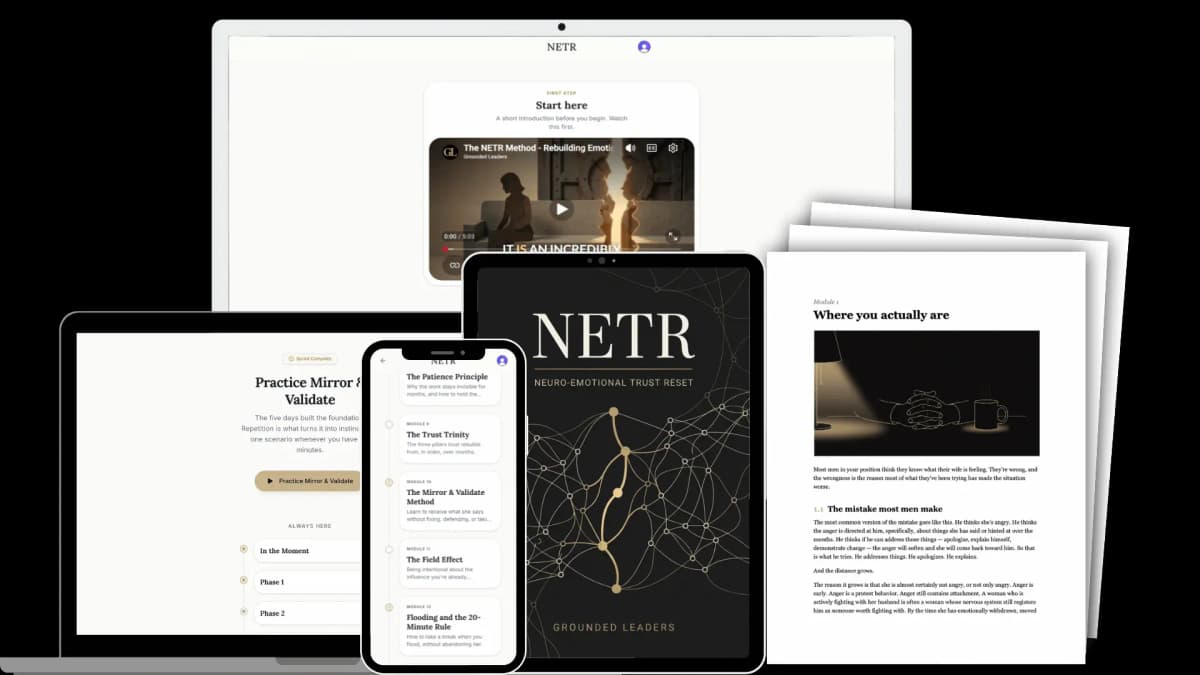
The NETR Method is a digital program consisting of downloadable PDF guide and a supporting web platform for interactive exercises etc. It is accessible from any device with an internet connection — computer, tablet, or smartphone — so you can go through the material at your own pace, whenever and wherever is most convenient for you.
Absolutely. We understand the sensitive nature of this situation. Your purchase is 100% confidential. The charge on your statement will appear under a discreet name to protect your privacy.
The core concepts can be learned in just a few hours. However, this is not a race. The program is designed for you to go at your own pace. We recommend setting aside 2-3 hours per week to watch the videos and, most importantly, apply the concepts. The real change happens not in watching, but in doing.
Right now you've got two options.
Option A
Keep doing what you're doing.
Hope things magically fix themselves. Watch the emotional distance grow. Keep wondering what could've been.
Option B
Take action today.
Use a proven, psychology-backed method to reset how she feels around you before it really is too late.