
If you are reading this, a thought has probably been sitting in your head for a while. Some version of: I do not know if I want to stay in this marriage. Or: I think I need to leave. Or: I cannot tell if what I am feeling is real or noise.
Most of what you can find on the internet about this question is bad in a specific way. It either rushes you toward an answer the writer already has, or it refuses to engage seriously with the question at all. Therapy sites tell you to communicate better and validate her feelings, as if the foundational issues in most failing marriages can be fixed with a weekend workshop. Relationship blogs tell you she has lost respect for you, or that she is going through a phase, or that you need to become a different kind of man, with confidence that goes well beyond what anyone could know about your specific marriage.
Both camps give you an answer before you have done the work to know what the answer should be. Neither takes seriously the actual diagnostic question, which is this: what is this marriage, what has been driving the deterioration, and what would the situation look like if you were running a different version of yourself through it?
This article is an attempt to do better. It is longer than most pieces you will find on this topic, because the question deserves length. It draws on research from serious social scientists who have spent their careers on marriage, divorce, and adult wellbeing. It does not tell you whether to stay or leave. What it does is give you a framework for making the decision honestly, with fewer of the errors that most men in your position make.
By the end, if you do the thinking carefully, you will have a clearer sense of what is actually happening and what your next step is. The next step may be to stay. It may be to leave. It may be to run a specific kind of experiment that ends in a real decision. All three are legitimate outcomes. The goal is not a particular answer. The goal is an honest one.
Why most men get this decision wrong
Before the framework, it helps to name the three ways men in your position typically fail at this decision. Each one is common. Each one produces bad outcomes. And most men in the middle of it do not realise which one they are running.
The drifter
The drifter never decides. He sits with the question for years, sometimes decades. He tells himself he will figure it out soon. He does not. The marriage deteriorates quietly around him. His wife often mentally leaves long before he does. He wakes up at fifty-five and realises he has spent a third of his adult life inside a decision he never actually made.
Drifting feels safe because it avoids the pain of either path. It is not safe. It is the path that costs the most, because it uses the most time. Every month spent not deciding is a month spent not living either life. The drifter is not choosing to stay. He is choosing to not choose. These are different things.
The impulse
The impulse decides in a hot moment. After a fight, after a crisis, after an affair revealed, after a breaking point that feels like clarity but is actually activation. He files. Or he walks away. Or he reconciles with a level of commitment his regulated self would not have endorsed. Two years later, looking back, he often cannot understand the decision he made. His nervous system was not in a state to make a good one, and he made one anyway.
This does not mean every impulsive decision was wrong. Sometimes a breaking point is also a correct diagnostic. But relying on the breaking point as the decision mechanism is dangerous, because most breaking points do not produce good decisions.
The ideologue
The ideologue imports a frame from somewhere else and applies it to his marriage. He reads a book or listens to a podcast that tells him his wife has lost respect for him, or that her behaviour reveals her true nature, or that men in his situation almost always choose wrong. He arrives at certainty without having done the diagnostic work, because the ideology did the work for him. The frame gives him a kind of clarity that feels satisfying. It is rarely accurate.
The other version of the ideologue imports the opposite frame. He decides that staying is always the right answer, or that any man considering leaving is running from his responsibilities. This is the same error in the opposite direction. Clarity without examination. Certainty without work.
Each of these three failure modes is a way of avoiding the actual question. The question is specific, and it requires specific thinking. A useful companion piece, if you want to see these in more detail, is Stay or Leave Your Marriage: What Men Usually Get Wrong.
What the thought of leaving actually is
The thought in your head — the one that says you should leave, or that you do not love her anymore, or that this cannot continue — is not the same as data about your marriage. The thought is an output. Something produced the thought. Before you treat the thought as evidence, you need to know what produced it.
When men in this position trace their thought carefully, it almost always turns out to have one of four origins. Sometimes more than one. Knowing which one is running matters enormously, because each origin implies a different next move. If the thought itself is the thing distressing you, Is It Normal to Think About Leaving Your Marriage? is the companion piece on that specific experience.
Sober observation
You have watched the relationship over time. You have seen specific things, multiple times, in states where you were rested and clear. You could describe what you have seen to someone you respect without raising your voice. If the thought has this origin, it deserves weight.
Most men in your position believe they have this kind of data. Most of them, on examination, do not. The next three categories describe where the data usually actually comes from.
A dysregulated nervous system
If you have been running in a low-grade alarm state for months or years, your brain is not an accurate instrument. It reads neutral cues as threats. It reads mild disappointment as catastrophe. It generates thoughts of leaving the way a panicking body generates thoughts of running.
Stephen Porges, a neuroscientist who has spent four decades studying the autonomic nervous system, has shown that humans are constantly scanning the environment for safety at a level below conscious thought. When the system reads safety, you can be curious and connect. When it reads threat, your thinking narrows to defence and escape. The same marriage, the same wife, the same kitchen feels completely different depending on which state you are in. Men who have been in the second state for months end up convinced the marriage is the problem. Sometimes it is. Often it is the state.
Consumed content
You have been reading, watching, or listening to material that primes you toward leaving. A podcast host told you that most men stay in marriages they should have left. A friend who left his wife says he feels alive again. A book told you that settling is a form of self-betrayal. None of this is necessarily wrong. But it is not your marriage. It is a lens you are now viewing your marriage through.
There is real research on this. A study of a large community sample found that when someone in your social network divorces, your own probability of divorce rises meaningfully in the following years — not because anything in your marriage has changed, but because the field of what feels possible has shifted. Divorce, statistically, is contagious. If someone in your life recently left their spouse, or if you have been consuming content about men who did, you are probably receiving signals that are affecting your reading of your own situation.
Unprocessed activation
Something in your history, not your marriage, has been touched. Her voice reminds you of your mother's voice. Her withdrawal reminds you of a childhood in which withdrawal meant abandonment. Her criticism lands on a shame that was there before you met her. Your body is reacting to a ghost. You are interpreting the reaction as a signal about her.
If this is running, it does not mean the marriage is fine. It means the marriage might not be the thing that needs changing, and you might be working on a problem that has a different address than the one you have been using.
Most men's thoughts of leaving are a mix. Sober observation tangled with dysregulation, consumed content, and old activation. That is normal. The point is not to discover that the thought is pure in one direction. The point is to see what is in the mix, so that when you decide, you are deciding from something reliable.
Three ways to answer the question, not two
Most men frame this decision as binary. Stay or leave. It is not binary. Framing it that way is one of the reasons the decision feels impossible to make.
There are three legitimate answers, and the third one is often the right answer when the first two are not yet clear. For a focused walk-through, see How to Decide Whether to Save Your Marriage or Not.
Option one: fight for it
You conclude that the marriage is genuinely workable. That the foundational work has not been done, or has been done incompletely. That when you run a better version of yourself through the marriage, there is real room for the situation to change. That your wife is capable of meeting you, even if she is currently constrained by her own patterns or state. That no fundamental incompatibility has appeared that would make the work pointless.
Fighting for a marriage is not a feeling. It is a specific kind of work, sustained over six to eighteen months, usually involving structured change to your own nervous system regulation, your self-concept, and the patterns you have been running without noticing. Most men who think they are fighting for their marriage are doing something smaller — apologising more, scheduling more date nights, reading a book or two. Those are not the work. The work is foundational and sustained.
Option two: let go with integrity
You conclude that the marriage needs to end. Maybe you have identified a fundamental values mismatch that was there from the start. Maybe the erosion has gone past a point that can be repaired. Maybe one of you has been doing the work and the other has not, and it is clear the gap is not closing. Maybe the life you actually want requires a shape that cannot be built inside this marriage.
Letting go with integrity is also not a feeling. It is the work of ending a marriage without becoming someone you will regret being. It involves legal and practical logistics, co-parenting arrangements if you have children, the emotional work of grief, and identity rebuilding. The first year after separation is one of the hardest periods in most adult men's lives, and men who underestimate it do damage that takes years to repair.
Option three: ninety days of honest effort
You conclude that the data you have been working from is not reliable. You have been running patterns that distorted what you were seeing. You have been in states that made your reading of her and of the marriage unreliable. You need better data before you can decide.
Option three is a structured, time-limited attempt to change what is yours to change, run the marriage through the better version of yourself for a defined period, and see what the data looks like at the end. It is not indecision. It is the honest answer when the first two options are not yet clear.
Done well, ninety days resolves the question. By day sixty or seventy, one of two things usually becomes clear. Either the marriage has substantial life in it, which you could not see before because you were running unreliable patterns. Or the marriage is over, which you also could not see before because you were hoping it was not.
Done badly, option three becomes another form of drifting. The discipline that makes it work: real change on your part (not performance), no announcement to your wife that you are running an experiment (no ultimatums, no timelines), clear markers for what you are observing, and a firm end date where you actually decide. If you have been sitting in the middle of the question for a while, What to Do When You Don't Know if You Want to Stay Married is the specific piece for you.
What the research actually shows
Before you decide, a few findings from serious research are worth knowing. They will not tell you what to do. They will sharpen how you think about it.
Unhappy marriages often do not stay unhappy
In 2002, a sociologist named Linda Waite led a study following adults who described themselves as unhappily married over a five-year period. Of the unhappily married adults who stayed married, roughly two-thirds reported being happily married five years later. Of the most unhappy subset — the ones who rated their marriage most negatively — about eight in ten who stayed together reported being happily married five years later. The adults who divorced, on average, did not report being happier five years on than the adults who stayed.
This is not an argument that every unhappy marriage should continue. Waite's team was careful to note that marriages involving violence or severe abuse were a separate category, and leaving those was associated with better outcomes. What the research does tell you is that the prediction most unhappy people make about their own future emotions is usually wrong. The feeling of this year is not reliably the feeling of five years from now. This matters because your brain is probably running the opposite assumption — that the pain of the current year will extend indefinitely unless you act.
Children and divorce
If you have kids, the research here is worth knowing carefully. Paul Amato, a sociologist who has spent his career on this, has done multiple meta-analyses. The broad finding is that children of divorced parents, on average, show modest negative effects compared to children of continuously married parents. Modest, not catastrophic. Measurable, not determinative.
The more specific finding matters more: the outcome for children depends heavily on the conflict level of the marriage and on the post-divorce relationship between the parents. Children in high-conflict marriages that end often do better than children in high-conflict marriages that continue. Children in low-conflict marriages that end usually do worse than if the marriage had continued. There is no general answer to the question of whether staying together for the kids is right. The real question is what environment they are actually living in and what environment they would be in after whatever change you make.
One more finding worth knowing: father involvement matters more than family structure. A father who is physically present but emotionally absent does less for his kids than a father who lives in a different house but is meaningfully involved. The question is not whether to stay to provide a father presence. It is in which configuration you would actually be the father your kids need. The dedicated piece on this is What the Research Actually Says About Staying Together for the Kids.
The single strongest predictor of late-life wellbeing
The Harvard Study of Adult Development has been running since 1938. It has tracked hundreds of men and their children for more than eighty years, through every major life decision they made. The finding that has held up across the entire study: the single strongest predictor of late-life wellbeing is the quality of your close relationships. Not wealth. Not achievement. Not health behaviours, except insofar as they are driven by close relationships. The people you let know you well, and who let you know them, are the load-bearing structure of a life that works.
This is not an argument for staying in this marriage. Close relationships can be inside a marriage. They can be in friendships. They can be in a blended family after an honest separation. What the research tells you is that whatever you decide, you need to take the relational structure of your life seriously. A decision that leads you toward a life of genuine connection, in whatever form, is a decision the evidence backs. A decision that leads toward isolation or a series of transactional relationships is not.
Contempt as the clearest warning sign
John Gottman, a psychologist who has spent over forty years observing couples, has found that the single best predictor of divorce is contempt. Not anger, not frustration, not criticism. Contempt — the posture of looking down on your partner, which shows up in tone, eye rolls, sarcasm, dismissive sighs. Gottman can predict with unusually high accuracy, from a few minutes of observation, which couples will divorce, based largely on whether contempt is present.
If you recognise contempt running in either direction in your marriage — yours toward her or hers toward you — the situation is in a more serious category than general difficulty. This does not mean the marriage is over. It means it requires specific intervention, and usually outside help, because contempt rarely repairs through effort alone. The full breakdown of Gottman's diagnostic is in The Gottman Four Horsemen: Patterns That Predict Divorce.
What the wise man actually asks
A man who knows how to think about this decision does not ask ‘should I leave’ as his first question. He asks a set of prior questions that the decision then follows from.
Aristotle, writing twenty-three hundred years ago, argued that the good life is not the life of pleasure or the life of achievement. It is the life of developed character expressed in meaningful activity over a long period. He would ask you what you are for. What do you do that, if you did more of it, would constitute your life going well?
The Stoics would ask you what you control and what you do not. They would point out that most of the things you currently think your happiness depends on are outside your control — your wife's behaviour, your children's futures, your own fluctuating moods. What you actually control is your character. Their question: are you building a life in which your wellbeing depends mainly on things you can shape?
Confucius would ask you who depends on you and how you are showing up for them. Not as a duty-based guilt trip, but as a real question about the relational structure of your life. How you discharge your obligations to the people in your orbit is, in the Confucian view, who you are.
Viktor Frankl, a psychiatrist who survived Auschwitz, would ask you what gives your life meaning. Not what gives you pleasure. Not what makes you successful. What makes your life feel like it matters. He believed this was the most important question a person could ask.
None of these thinkers would agree with the others. They would each offer a different frame. The wise man's work is to hold all of them at once, try each one, notice what each reveals, and integrate. What am I for. What do I control. Who depends on me. What gives my life meaning. Those four questions, asked together, sharpen the marriage question in a way that asking about the marriage directly never does.
The question is not whether to leave the marriage. The question is what kind of life you are actually trying to build, and whether this marriage fits inside it. You cannot decide the second question without having answered the first.
Four things you probably have not examined
Most men evaluating their marriages are evaluating something specific — the version of the marriage that exists when they are running certain patterns inside it without knowing they are running them. The evaluation is not wrong, but it is incomplete. If you are missing any of the following four capacities, the marriage you are evaluating is not the marriage you would have if you had them.
Nervous system regulation
When your nervous system is regulated, you can be in a room with someone who is upset with you and your body does not panic. You can hear a criticism without immediately needing to defend. You can see her in a cold mood and not interpret it as the end of the world. When your nervous system is not regulated, the opposite is true. Everything she says is processed by a body on alert. Every interaction reads through a filter of threat. Any marriage run through this filter for years will feel dead even if it is not. The foundation work is covered in our NETR Method pillar.
The ability to hold tension without appeasing
When someone you love is upset with you, your body runs a very old program. It wants the tension to stop. For many men, the program that fires is not fight, and not flight. It is appeasement. Explain. Agree too quickly. Apologise for things that do not require an apology. Over-give. Smooth it over. Each time you appease, you teach your nervous system that her disapproval is unbearable, and you teach her that your word is up for negotiation. Over years, this creates a marriage in which nothing you say can be taken at face value. She does not know if your yes is real or a strategy. Because she does not know, she cannot fully trust you, even when she wants to.
A self-concept anchored inside you
When you imagine her leaving, what happens in you? If the answer is grief, that is normal. If the answer is a collapse of who you are, something else is going on. Some significant part of your self-concept has been anchored outside you, in her, in the relationship, in being chosen by her. A man with that anchor creates a subtle pressure that most women find, over time, exhausting and unattractive. Her nervous system has to carry the weight of your identity alongside its own. Given enough years of this, she usually pulls away — not because she has stopped loving you, but because the weight has become too much. The work of rebuilding self-concept from the inside is in Unshakable Identity.
The capacity to disagree while staying connected
Most men cannot disagree with their wives without either becoming cold or capitulating. Disagreement, in their internal map, means disconnection. You either win by pushing harder, which means disconnection for the duration of the fight, or you concede to preserve the connection, which is appeasement. The couples who stay happy over time are not couples who disagree less. They are couples who stay warm during disagreement — who can say ‘I disagree, and I still love you,’ and mean both. If you cannot do this, you have not yet developed the capacity that makes long-term intimate partnership stable.
These four capacities are not things a man is born with. They are built through practice, usually with some kind of structure, over months. Almost no man reading this has them all in place. Before you decide the marriage is over, it is worth knowing honestly how much of what you are reading as ‘the marriage’ is actually the absence of these capacities in you.
What to do next
If you have read this far, a few things are probably clearer than they were. Knowing that clarity came from an article, not from the hours of specific work the decision actually requires, here is what I would suggest next.
First, trace the origin of the thought. Sit down with paper — not your phone — and answer these questions honestly. When did the thought of leaving first show up? What was happening in your life that month? What were you consuming? What was the state of your own body, your sleep, your training, your discipline? Who around you had recently gone through a breakup or divorce? Is the thought stable across different states of your life, or does it track your own activation?
Second, get specific about what is actually happening in the marriage. Not a general sense. Specific examples from the last thirty days. Things you could describe to a friend you respect without raising your voice. If you cannot describe what is wrong in specific terms, the picture you have in your head is not yet clear enough to act on. If part of what you are noticing is her pulling back, Signs Your Wife Has Emotionally Checked Out of the Marriage helps you read her more accurately. If the feeling that keeps returning is that you no longer love her, Falling Out of Love With Your Wife: What It Actually Means is the piece on that specific experience.
Third, honestly examine the four capacities. Rate yourself on each one from one to ten, not how you would like to be, but how you actually are on a normal Tuesday. The largest gap is usually where the leverage is.
Fourth, do not decide yet. Most men in your position make the decision too early, before they have done any of this work. The decision becomes obvious once the work is done. Forcing a decision before the work is done usually produces a bad one.
Fifth, if the situation is acute — if she has told you she wants a divorce, if there are kids being damaged by ongoing conflict, if you are deteriorating in ways that are affecting your health or your work — the timeline for this work is shorter, and you probably need help. This is not a character judgement. Some situations are too complex or too time-pressured to sort alone. If your wife has just mentioned divorce, Your Wife Said She Wants a Divorce: What to Do in the First Seven Days is the calm, specific guide for the first week. Outside help, from a therapist or a coach or both, often makes the difference between doing this well and doing it badly.
Frequently asked questions
The short answers men in your position most often come here looking for. Each one is treated at more depth somewhere in the article above, or in the spoke articles linked throughout.
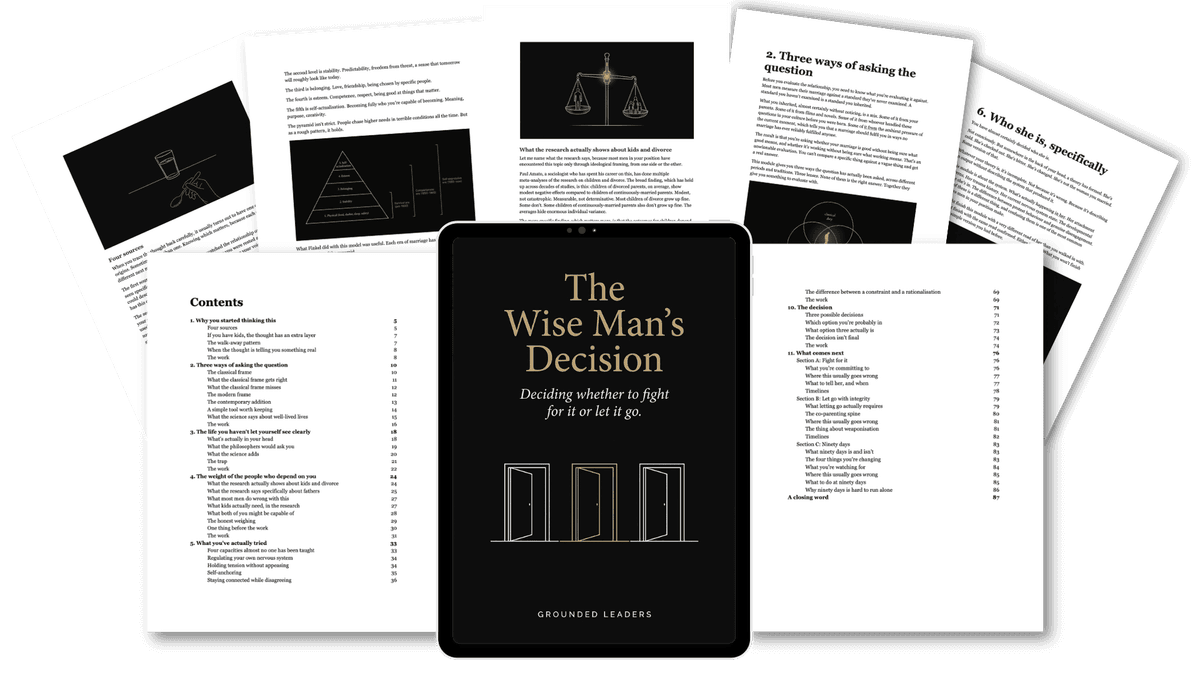
The full framework, in the form this decision actually deserves.
This article compresses into about four thousand words a framework that actually takes much longer than one reading to work through properly. The full version is The Wise Man's Decision — eleven modules and roughly thirty-one thousand words, structured as a guided inquiry.
Each module ends with specific prompts that turn the reading into the actual decision-making work. By the end, you have an honest answer: fight for it, let go with integrity, or ninety days of structured effort followed by a decision.
Get The Wise Man's Decision →$97 · One-time payment · 30-day refund
Whatever you decide, decide honestly, and decide with full use of what you can see.